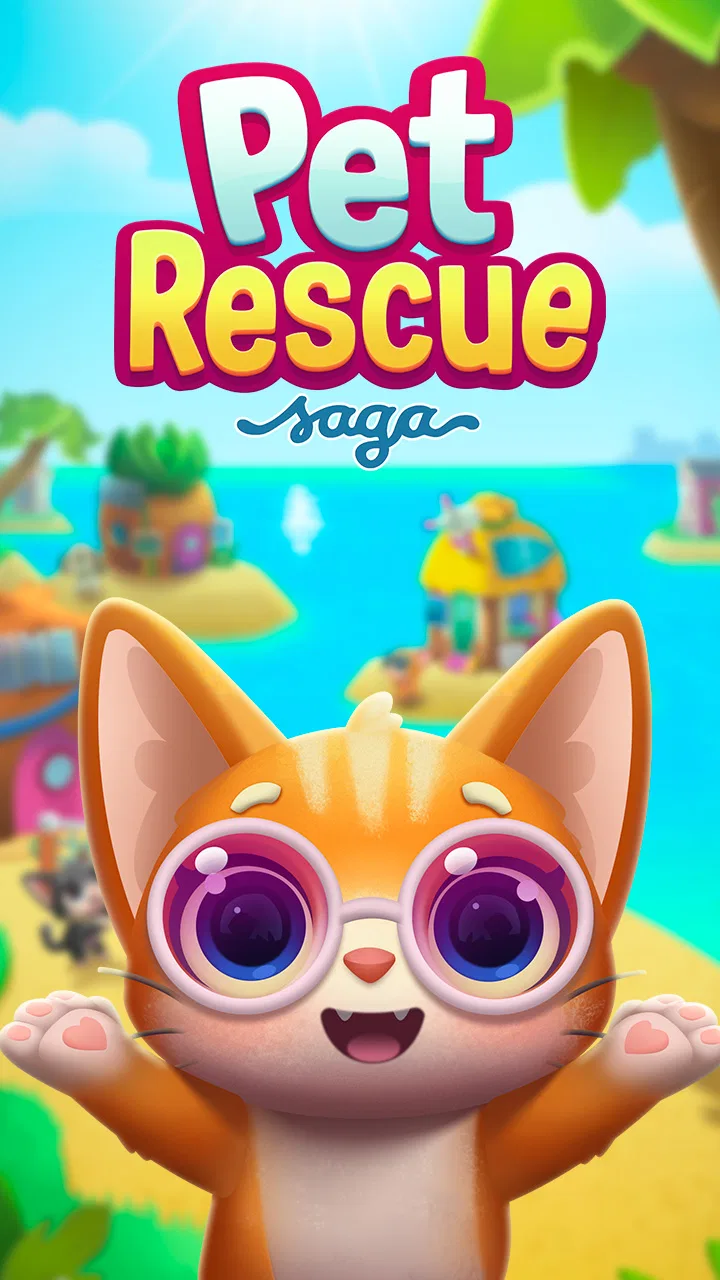
Pet Rescue Saga
- 4.2
- Rating
- 100.00M
- Installs
- Free
- Price
 Analysis by App-foxy
I keep coming back to Pet Rescue Saga for one simple reason: it gives me a quick puzzle to solve without demanding a long, uninterrupted gaming session. The idea is easy to understand at a glance—clear matching blocks, earn points, and help trapped pets—but the best part is how quickly the game turns a spare moment into something satisfying. I can start a level while waiting for a coffee, play for a few minutes, and stop without feeling as though I have abandoned a complicated story or unfinished multiplayer match.
That makes this a very approachable casual puzzle game, but “easy to start” does not always mean “mindless.” The board often rewards me for looking ahead rather than tapping the first available group. A careless move can leave awkward pieces behind, while a little patience can create a much cleaner route for the animals. It is a pleasant balance: the rules are friendly enough for a new player, yet the better decisions become clearer only after I have made a few mistakes.
King developed the game, which originally arrived on June 3, 2013. It is free to download and aimed at Everyone, so it is suitable for a broad family audience. The game has reached over 100 million installs, with a 4.2 average from around 3.4 million ratings and roughly 189 thousand written reviews. Those figures suggest a long-running audience, but my recommendation is based less on its popularity than on how well its short, stop-and-start rhythm works in everyday use.
You May Also Like

 AccuWeather: Weather Radar
AccuWeather Review: A Quick, Clear Forecast for Everyday Decisions
For everyday plans, the best forecast is the one you can understand quickly. AccuWeather makes rain timing, radar, and local conditions easy to act on, with a few trade-offs.

 Hill Climb Racing
Why Hill Climb Racing Still Turns Crashes Into One More Run
A tiny car, a bumpy hill and one more upgrade: Hill Climb Racing keeps resurfacing because its simple chaos makes every near-miss feel personal.

 AliExpress - Shopping App
AliExpress Makes Global Shopping Feel Personal, but Shoppers Bear the Risk
AliExpress turns a global marketplace into a pocket-sized discovery engine. Its reach is useful, its shopping loop compelling, and its trade-offs easy to miss.

 Lords Mobile: Kingdom Wars
Lords Mobile Is a Kingdom-Building Routine, Not a Quick Match
A case-by-case verdict on the building, battles, device demands, and social commitments that make Lords Mobile rewarding for some players and exhausting for others.

 PDF Scanner app - TapScanner
TapScanner Makes Paperwork Easier to Capture, Check, and Share
TapScanner makes scanning with a phone feel less like a rescue operation and more like a dependable step in getting work done. Its capture tools are useful, though not flawless.

 Block Blast!
 Shows How Much a Puzzle Game Can Leave Out
A quiet grid game shows why puzzle players increasingly value instant clarity, repeatable skill and low-pressure play—and where the genre still needs to catch up.
More From Our News Desk
View All News


Why the first few minutes feel so clear
The opening appeal comes from the visual simplicity. I see a compact puzzle board, colored blocks, and pets that need a safe path downward. Matching adjacent blocks of the same color removes them, allowing the pieces above to fall. That basic interaction is immediately readable, so I do not need a lengthy explanation before making my first useful move.
What keeps the game from feeling like a single-button exercise is the need to manage the whole board. Removing one group changes what sits above it, and that can either open a route or create a new problem. I have learned to pause for a moment before tapping, especially when a pet is positioned above several possible groups. The largest cluster is not automatically the best choice if it prevents a later connection.
The rescue theme gives each level a clear purpose. Instead of simply chasing a high score, I am usually thinking about how to bring the animals down safely while also satisfying the level’s goals. That small layer of responsibility makes a failed attempt more understandable: I can usually identify the move that closed off a route or wasted a useful group.
The most useful early habit is to scan the bottom half of the board before making the first move. If I remove blocks near the top too quickly, I may create a pleasing cascade but leave the lower area fragmented. Looking from the pets upward helps me prioritize the route instead of being distracted by the biggest group on screen.
A better way to approach each board
I do not treat every matching group as equally valuable. A small group can be strategically important if it connects two colors or clears a narrow passage. A larger group can be tempting but harmful when it drops a pet into a position that is harder to recover. This is where the game’s casual presentation hides a modest amount of planning.
When several moves are available, I usually ask myself three questions. Which removal changes the board most usefully? Does it create a larger group on the next turn? Will the falling pieces move a pet closer to safety or block the route? These questions take only seconds, but they make the difference between playing deliberately and simply tapping whatever looks bright.
Another practical tip is to avoid spending every helpful group immediately. Holding a connected cluster for a turn can allow pieces above it to settle into a better arrangement. I find this especially valuable when the board contains several pets at different heights. Clearing too aggressively may help one animal while making the others difficult to reach.
The game also works well for players who do not want complex controls. There is no need to master a virtual joystick, memorize a large inventory, or learn a long list of character abilities. The challenge comes from timing and board reading, not from dexterity. That makes it a comfortable choice for a quick mental break rather than an intense action session.
Short sessions, interruptions, and returning later
This is where the game earns its place on my phone. A level has a natural beginning and end, so I can approach it with a small amount of available time. If I have only a few minutes, I can play one attempt. If I have longer, I can continue through several boards. The structure does not require me to reserve an entire evening, which is exactly what I want from a casual title.
It is also forgiving in the way I use it around daily distractions. I can put the phone down when a message arrives or when I need to get off a bus, then return when I have a moment again. That interruption tolerance matters more to me than a large feature list. A game that punishes every pause would be a poor fit for waiting rooms, short commutes, or the few minutes before an appointment.
Still, I would not call every session completely frictionless. Puzzle games create their own kind of interruption: when I am close to solving a board, I often want to finish rather than stop. A quick break can become longer because I am trying “just one more” attempt. The levels are easy to start, but the rescue objective and score goals can make them surprisingly sticky.
For that reason, I use it differently depending on the situation. During a genuinely short wait, I play a level only when I am comfortable being drawn into a second attempt. When I need a clean, guaranteed stopping point, I avoid opening it. This is not a serious flaw, but it is an honest trade-off between convenience and the game’s ability to keep a failed board in my thoughts.
What returning players should watch for
Coming back after a day or a week is straightforward because the central interaction does not require extensive memory. I do not need to remember a complicated storyline or rebuild a control scheme. The first board I play usually refreshes my sense of timing. That makes the game more welcoming than many deeper puzzle titles, where a long break can make the return feel like starting over.
My advice is to resist replaying a difficult level with exactly the same opening move. If the first attempt left isolated blocks or trapped a pet, changing the first removal often teaches more than repeating the same sequence faster. I also pay attention to whether the board rewards a high score or simply safe rescue. Those goals can point toward different choices, and chasing both at once can make a level feel more frustrating than it needs to be.
The free-to-play structure is another part of the return experience. The game itself costs nothing to install, but optional in-app purchases range from $0.99 to $119.99 per item. I would set a spending limit before handing the phone to a child or allowing purchases on a shared device. The wide range means the game can remain a no-cost pastime, but it also means the purchase controls deserve attention.
I prefer to treat purchases as optional conveniences rather than part of the core appeal. If a board becomes irritating, I would rather take a break and return with a different approach than pay simply to remove the feeling of being stuck. Players who dislike any free-to-play pressure may find a paid puzzle game more comfortable, even if it offers fewer levels or a less polished progression system.
Immediate pleasure versus repetition
The immediate pleasure is real. Matching a group, watching the board settle, and seeing a pet move toward safety produces a small but clear reward. The feedback is understandable without being noisy, and the visual goal keeps the action from becoming abstract. I can tell why a move worked, which is important in a puzzle game that expects me to improve rather than merely react.
However, the same loop can become repetitive. The basic action remains the same across play: identify a useful group, remove it, observe the new arrangement, and continue. Players who need constant mechanical variety may lose interest, especially if they prefer games that introduce new controls or dramatically different challenges. This is a game about refining decisions within a familiar framework, not about reinventing itself every few minutes.
I think the repetition works best when I play in short bursts. A handful of levels feels relaxing because the pattern is comforting and the decisions remain light. A much longer session can expose the limits of the formula. Once I stop noticing the board and start tapping automatically, the game has stopped providing the kind of attention I enjoy from it.
That is also why it compares favorably with some endless matching games for short use. An endless format can be excellent when I want a score chase with no defined finish, but it can be harder to put down. Pet Rescue Saga gives me more immediate purpose through its rescue objective and level-based rhythm. On the other hand, a deeper puzzle game with fewer but more intricate boards may offer better long-term satisfaction for someone who wants demanding logic rather than accessible pattern recognition.
Compared with fast arcade alternatives, this game is calmer and less dependent on reflexes. I do not need to react to a timer in the same way I would in an action-focused casual game. Compared with match-three games that emphasize making individual combinations, its block-clearing layout asks me to think more about connected spaces and falling pieces. That difference is subtle, but it gives the game its own identity within a crowded category.
Three habits that improve the experience
- Read from the pets downward: I first identify the safest route for each animal, then choose the block group that supports that route. This prevents attractive top-row matches from dictating the whole board.
- Protect future connections: I avoid removing a useful color just because it is available. Leaving a group in place can allow falling pieces to join it later, producing a more valuable clearance.
- Separate rescue from score chasing: On a difficult attempt, I focus on getting the pets down instead of forcing a large combination. Once the route is reliable, I can replay with a higher score in mind.
These habits are not complicated techniques, but they change the feel of the game. They turn each board into a small planning exercise and reduce the sense that success depends on luck alone. They also show why the game can appeal to adults who want something simple on the surface but still appreciate a decision with consequences.
There are limits to how far that strategy goes. Some players will find the difficulty uneven, particularly when a board does not offer the arrangement they hoped for. I also think the game is less satisfying for anyone who wants a strong competitive layer, a rich narrative, or a constantly evolving set of mechanics. Its strengths are clarity and convenience, not depth in every direction.
Who should play it and who should skip it
I would recommend it to someone who wants a friendly puzzle for waiting periods, quiet evenings, or a short mental reset. It suits players who enjoy visible progress, simple controls, and objectives that can be understood immediately. It is also a reasonable choice for families because the age rating is Everyone and the central idea is easy to explain.
I would be more cautious about recommending it to a person who dislikes free-to-play design, even when they intend to avoid spending. The in-app purchase range is broad, and the possibility of optional purchases can change how comfortable the experience feels from one household to another. Anyone looking for a completely purchase-free environment may prefer a premium puzzle app instead.
I would also steer away from it if the main goal is a serious brain-training challenge. The game asks for planning, but it remains approachable and visually cheerful. It is not trying to be a dense logic simulator. Likewise, players who want competitive multiplayer, a long story, or fast reflex action should look elsewhere. This title is strongest when the desired mood is relaxed concentration.
On a normal day, I can imagine using it after finishing work, when I want something more engaging than scrolling but do not have the energy for a large adventure game. I can play a board, think through why a move failed, and put the phone away. That everyday usefulness is more convincing to me than the promise of endless content. It fills a narrow role well.
My casual verdict
Pet Rescue Saga is at its best when I judge it by the quality of a small session rather than by how long it can occupy me. It starts quickly, communicates its goal clearly, and gives each move enough consequence to make matching feel purposeful. The rescue theme adds warmth without making the game difficult to understand, while the block layout creates more planning than the bright presentation first suggests.
Its main weakness is the same quality that makes it accessible: the core loop can feel familiar for too long. The free-to-play purchase structure may also bother players who want a completely uncomplicated experience. I would not choose it over a premium logic game for deep challenge, or over an arcade game for rapid excitement. But for a few minutes of approachable puzzle play, it is dependable.
The current version is 4.12.1.0 and requires Android 6.0 or later. With its free entry point, Everyone rating, and long-established casual format, it is easy to try without committing to a complex game system. My advice is to play slowly enough to notice the board’s future shape, keep spending firmly optional, and stop when the satisfying puzzle rhythm turns into automatic tapping.
In the end, I recommend it to friends who want a game that can survive interruptions and still feel rewarding when they return. It is not endlessly novel, and it does not need to be. Its value is in making a short break feel complete: one board, one small plan, and the pleasant moment when a careful move gives the pets a clear way down.
FAQs for Pet Rescue Saga
01What is the main objective of Pet Rescue Saga?
Pet Rescue Saga is a puzzle game where the primary goal is to clear levels by matching two or more blocks of the same color to rescue pets trapped above. Players must strategically remove blocks to prevent the pets from reaching the bottom of the screen, all while managing limited moves.
02Are there any in-app purchases in Pet Rescue Saga?
Yes, Pet Rescue Saga offers in-app purchases. Players can buy boosters, extra lives, and additional moves to help clear challenging levels. While the game is free to download and play, these purchases can enhance the gameplay experience and help overcome difficult stages.
03Do I need an internet connection to play Pet Rescue Saga?
Pet Rescue Saga can be played offline, but certain features require an internet connection. For example, syncing your progress across devices, accessing leaderboards, and receiving updates or special events need internet access. Playing offline limits some functionalities but allows basic gameplay.
04How can I sync my progress across multiple devices?
To sync progress in Pet Rescue Saga across devices, connect the game to your Facebook account. This allows your game data to be saved in the cloud, ensuring seamless transition between devices. Simply log into Facebook on each device to continue from where you left off.
05Are there any social features in Pet Rescue Saga?
Yes, Pet Rescue Saga includes social features that enhance the gaming experience. Players can connect to Facebook to see friends’ progress, send and receive lives, and compete on leaderboards. Engaging with friends adds a competitive edge and provides support during challenging levels.
Pros
- Engaging puzzle gameplay with increasing difficulty.
- Colorful graphics appeal to all age groups.
- Frequent updates keep content fresh and exciting.
- Offline play mode available for uninterrupted fun.
- Easy to learn with intuitive controls.
Cons
- In-app purchases can be quite expensive.
- Energy system limits continuous playtime.
- Some levels require luck more than skill.
- Advertisements can be intrusive at times.
- No option to sync progress across devices.

Pet Rescue Saga
Gallery